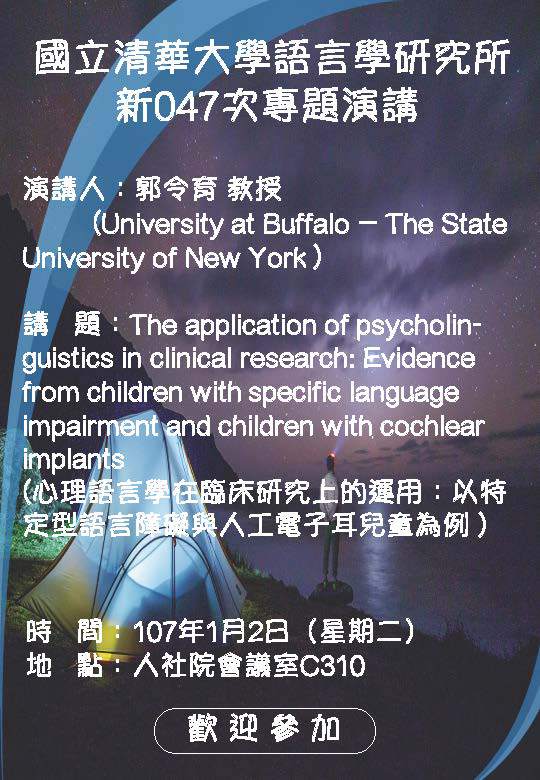
【演講】語言所 “The application of psycholinguistics in clinical research: Evidence from children with specific language impairment and children with cochlear implants”: 2018/1/2(二)12:30
※ 清華語言所新047次專題演講公告 ※
講者:郭令育 教授 (University at Buffalo – The State University of New York)
題目:The application of psycholinguistics in clinical research: Evidence from children with specific language impairment and children with cochlear implants
(心理語言學在臨床研究上的運用:以特定型語言障礙與人工電子耳兒童為例)
日期:2018年1月2日 (星期二)
時間:中午12時30分 開始
地點:人社院 C310 研討室
摘要: Psycholinguistic theories play a critical role in clinical research. In this talk, I will demonstrate how Levelt’s (1989) language production model can be used to reveal language deficits in children with specific language impairment. Our study showed that children with specific language impairment produced higher silent pause rate, but not filled pause rate, than their age-matched peers. In addition, children with specific language impairment produced more silent pauses than their age-matched peers before phrases, but not before any other syntactic constituents.
I will also demonstrate how lexical properties (e.g., neighborhood density, phonotactic probabilities) influence word learning in children with unilateral or bilateral cochlear implants. Our study showed that spoken vocabulary size positively correlated with average phonotactic probability and negatively correlated with average neighborhood density, but only in children with bilateral cochlear implants. These patterns of lexical acquisition were also observed in typically developing children in prior studies.
Together, our studies illustrate that psycholinguistic theories can help us identify the underlying deficits of children with specific language impairment and evaluate the treatment efficacy of unilateral and bilateral cochlear implants.